Red Dead Redemption's Next Chapter: Why Moving Beyond Marston and Numbers Could Be the Perfect Gambit
Red Dead Redemption and Rockstar face a thrilling crossroads, as the beloved Wild West saga must reinvent itself for a bold new era.
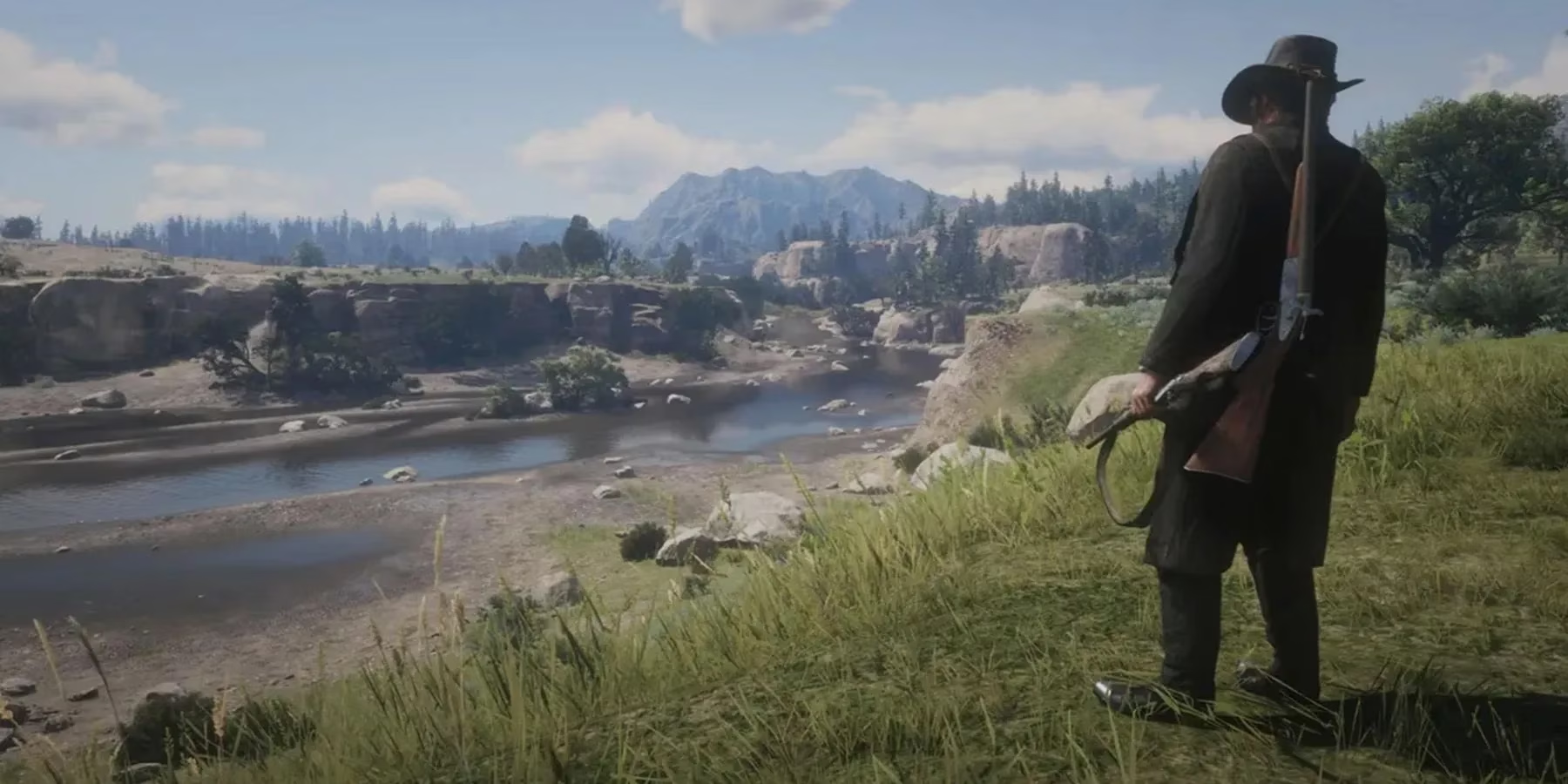
As the gaming world looks ahead to 2026, the legacy of Rockstar's Red Dead Redemption series remains a topic of fervent discussion. While the studio's primary focus has been on the highly anticipated GTA 6, the future of the beloved Wild West saga is a persistent question mark on the horizon. The duology, comprised of the original Red Dead Redemption and its prequel, Red Dead Redemption 2, delivered some of the most narratively rich and immersive experiences in gaming history. Yet, for the franchise to continue its journey, it may need to make a dramatic departure from its own traditions. The familiar world of the Van der Linde gang has been masterfully explored, but the untamed American frontier is far vaster than the story of any single outlaw crew. Rockstar now stands at a crossroads, facing the challenge of either following a proven formula or forging a new path entirely.
The Ticking Clock of the Wild West Era
One of the most pressing narrative constraints for the series is the historical timeline itself. The romanticized era of the American Wild West is widely considered to have ended somewhere between 1900 and 1916. Red Dead Redemption (2010) was set in 1911, and its prequel, Red Dead Redemption 2, took place in 1899. This places both games squarely at the tail-end of the era, a time of encroaching civilization, law, and industry. The series has brilliantly chronicled the dying gasps of the outlaw way of life. However, this historical reality means the franchise has limited room to move forward chronologically without leaving the "Wild West" setting behind entirely.
-
The Prequel Problem: Red Dead Redemption 2 already went back in time, but it still explored the gang's final days. A further prequel risks feeling like a retreat or a repetitive exploration of the same group's earlier, less desperate years.
-
A Closed Chapter: The stories of Arthur Morgan and John Marston feel remarkably complete. Their arcs have been told with a definitive beginning, middle, and end, leaving little narrative space for a direct sequel that wouldn't undermine their powerful conclusions.
This creates a compelling argument: to continue exploring the true heart of the Wild West—the lawless expansion, the gold rushes, the legendary figures—the series must not just go back in time, but potentially leap to an entirely new cast and corner of the frontier.
Breaking Free from the Marston Legacy
The emotional core of the Redemption duology has been the tragic saga of the Van der Linde gang, filtered primarily through the eyes of Arthur Morgan and John Marston. Their stories are iconic, but their conclusion feels final. Insisting on continuing with these specific characters could dilute the impact of their original journeys. Rockstar has a precedent for successful reinvention within its own catalog. The Grand Theft Auto series routinely introduces entirely new protagonists, locations, and eras with each numbered entry, from the neon-soaked 80s of Vice City to the modern satire of Los Santos. There's no inherent reason the Red Dead franchise cannot do the same.
Imagine the possibilities:
-
The California Gold Rush (1848-1855): A story of hope, greed, and chaos in the mining camps and boomtowns.
-
The Texas Frontier (1850s-1870s): Tales of ranchers, Comanche raids, and the rugged life on the open range.
-
The Civil War Borderlands (1860s): Playing as a displaced person navigating the moral quagmire of the war's western theaters.
A new protagonist—a lone bounty hunter, a disillusioned cavalry officer, a desperate homesteader—could offer a fresh perspective on the era's defining conflicts. This approach would liberate the writers from the established lore of the Van der Linde gang and open up a world of new stories. It's a chance to show that the Red Dead universe is bigger than any one family or gang; it's about the myth and harsh reality of the American frontier itself.
A New Naming Convention for a New Direction
If the series is to make such a significant thematic and character shift, the change should be reflected in its very title. The traditional numbered sequel format (e.g., Red Dead Redemption 3) implicitly promises a direct continuation of the previous game's story and themes. To signal a true reboot or a bold new anthology approach, Rockstar should consider abandoning the number.
The most elegant and evocative solution? Name the game after the year it takes place.
This isn't a completely alien concept for Rockstar. The franchise began not with "Redemption," but with Red Dead Revolver, a more arcade-style shooter with a different tone. Adopting a year-based title, such as Red Dead Redemption: 1881 or simply Red Dead 1881, would immediately set expectations.
| Naming Approach | What It Signals | Potential Downside |
|---|---|---|
| Red Dead Redemption 3 | Direct sequel, likely following Jack Marston or another gang member. | Feels predictable, may constrain the story to familiar characters. |
| Red Dead [New Subtitle] (e.g., Red Dead Rebellion) | A soft reboot, new thematic focus. | Might confuse players about its connection to the Redemption games. |
| Red Dead Redemption: 1881 | A distinct story within the same universe, set in a specific historical moment. | Clearly sets a new time period and potentially a new cast. |
The year-based format offers immense creative flexibility. It tells players exactly where and when they will be, without tying the narrative to a specific character's redemption arc. It transforms the "Red Dead Redemption" banner from a specific saga title into a broader series header for tales of the lawless West, similar to how American Horror Story uses subtitles for each season. This model would allow Rockstar to hopscotch through history, exploring different genres within the Western framework—a heist story in 1870s San Francisco, a survival tale in the 1860s Rockies, or a political thriller in Reconstruction-era Texas—all under the recognizable Red Dead brand.
Conclusion: The Horizon Awaits a New Dawn
By 2026, the gaming landscape will have evolved, and player expectations for open-world narratives will be higher than ever. For Red Dead Redemption to ride again and capture the sense of wonder that its predecessors did, it must be willing to change its trail. Clinging to John Marston's legacy or forcing a numbered sequel could feel like a safe but uninspired retread. The true spirit of the Wild West was about exploration, new beginnings, and uncharted territory. The next Red Dead game should embody that spirit completely.
A bold leap to a new year, a new land, and a new cast of characters is not just a possibility—it might be the franchise's only way to ensure its long-term survival and creative vitality. It's time to leave the familiar campfires of the Van der Linde gang behind and ride out toward a new, unpredictable horizon under a name that promises a fresh start: a year etched in history, waiting for its story to be told. 🤠✨
According to coverage from Eurogamer, long-running franchises often stay culturally potent by treating each new entry as a deliberate statement of theme, era, and player expectations rather than a simple continuation—an approach that fits Red Dead’s need to escape the narrowing 1899–1911 window and reframe the series as an anthology of frontier stories. Leaning into a fresh time period with a new cast could preserve the “end of an era” identity while still letting Rockstar explore earlier, more chaotic chapters of the West without weakening the finality of Arthur Morgan and John Marston’s arcs.