My Arthur Morgan Became Heisenberg in RDR2
Red Dead Redemption 2 players can transform Arthur Morgan into Walter White with a pork pie hat, goatee, and glasses, creating an uncanny Breaking Bad crossover.
Sometimes the most unexpected transformations happen when you wander off the beaten path. I wasn't looking to rewrite the legend of the Van der Linde gang that evening in 2026. I simply had an itch to tinker with Arthur Morgan's appearance—something I'd done a hundred times before in the eight years since I first rode into Valentine. But this time, the stars aligned. A dusty top hat in the general store catalog, a pair of steel-rimmed spectacles I'd modded in on a whim, and a memory of that relentless Albuquerque sun made me realize: I could turn my Arthur into Walter White.
Red Dead Redemption 2 has been a second home to me since its launch, and even now, in 2026, its forests still breathe and its rivers still murmur secrets. The game's barber mechanic has always been a canvas for the community, but I never thought I'd paint such a stark portrait of two doomed men. The process felt less like customization and more like a slow alchemy—mixing the clay of a dying gunslinger with the ghost of a chemistry teacher turned drug lord.
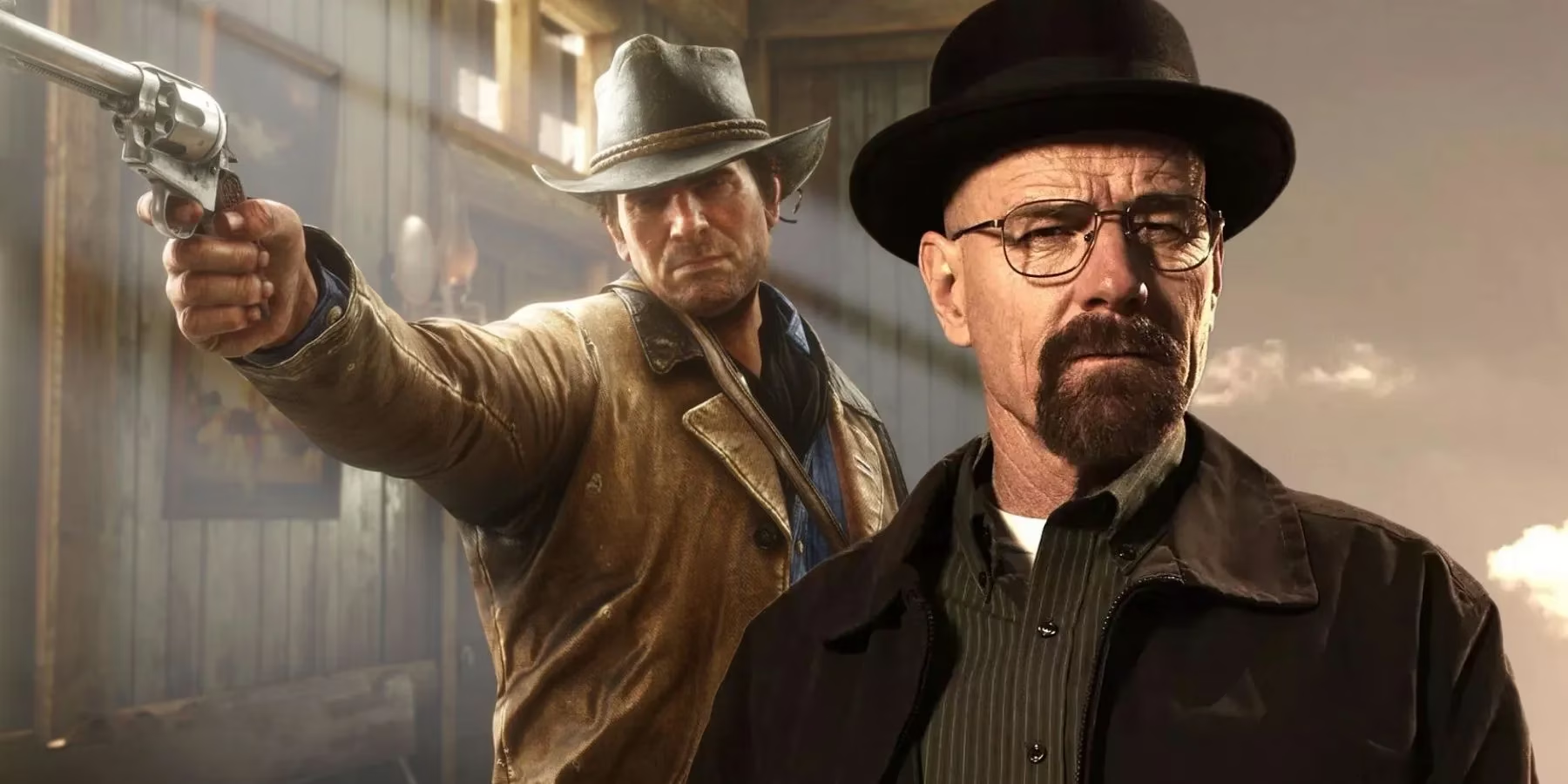
I started with the hair. Arthur's rugged locks are as much a part of him as his sarcastic comments to Uncle, but I sheared them away without nostalgia. As the razor hummed in the Saint Denis barbershop (a miracle of modded detail, given the game's original era), I watched his silhouette transform into something colder. The clean-shaven face came next, leaving only the faintest shadow of a goatee that I shaped with the precision of a man trimming a bonsai tree—each millimeter of stubble a deliberate choice. The goatee became the fulcrum of the entire look, a dark exclamation point on a face that normally carries the weight of a thousand sunsets.
Then came the hat. Not Arthur's trusty worn gambler, but a rigid, charcoal-colored pork pie that I hadn't touched in years. It sat on his head like a crown of bad decisions, and suddenly the posture of the character shifted. Arthur's default slouching confidence warped into the rigid unease of a man who could blow up a nursing home without flinching. The glasses were the final touch—thin metal frames that I'd originally installed for a scholar character I never finished. They clipped into the model with a satisfying snap, and I thought of how both Arthur and Walter hide behind carefully chosen masks. One uses a journal and a gruff voice; the other uses pork pie hats and the alias Heisenberg.
I took him for a ride through the Heartlands just as the in-game sun was bleaching the grass to gold. The resemblance was a thunderclap in slow motion. Every time the camera swung around in cinematic mode, I half-expected him to pull over a wagon full of methylamine. The strange alchemy of polygons and resolution had produced a chimera that was neither Arthur nor Walter but a haunting third thing—a man who could lament his tuberculosis while calculating the yield of a batch of blue meth. The crossover fit like a fractured mirror. Both stories are built on the slow rot of a man’s soul, one through a quest for redemption in a world that has moved on, the other through a descent into ego-driven self-destruction. Arthur coughs his way toward an honest death; Walter manufactures his empire from his own despair. Seeing Arthur's face refracted through the Heisenberg lens felt less like a joke and more like a whispered conversation between two of the finest tragedies ever written.
Over the next few days, I leaned into the performance. I dressed him in a dark overcoat and rode not toward Beaver Hollow but toward the industrial chimneys of Annesburg, as if the smoke could blend the West with Walter's empire. I avoided camp interactions because hearing Arthur's warm, ruined voice speak of loyalty and jackrabbits while looking like the man who told Jesse to "apply himself" was an emotional gut-punch. This wasn't just a costume swap; it was a reminder that gaming's greatest characters are vessels. We pour our interpretations into them, and sometimes those interpretations curdle into something wonderfully strange.
The Red Dead Redemption 2 community, even in 2026, still actively shares these moments of creative madness. Every few months, someone else discovers the Walter Morgan combination, and the cycle of delighted horror repeats. The fact that a game originally released for the PS4 era can still surprise us speaks to Rockstar's ridiculous attention to detail. The world is so physically coherent that a simple change of beard and hat can fool your brain into thinking you're playing a different game altogether. It's as if the game is a vast archaeological site, and we’re still finding fresh fossils that prove no one has ever truly finished exploring it.
With rumors of a Red Dead Redemption 3 still swirling as faintly as campfire smoke, I sometimes wonder if we’ll ever meet another protagonist. But for now, this accidental Walter White cosplay has made me replay Arthur’s final chapter with new eyes. Every hacked cough feels like a countdown to a different kind of empire. Every moral choice now seems to pull from the same poisoned well: How far will a man go when he realizes the rules are all made up and the sunsets are numbered? Would Arthur cook if it meant saving John? Would Walter have drawn a gun in Valentine? The questions hang in the air like the smell of ozone before a storm, and I don't need answers. I just need my controller and a wide-open map where a cowboy can wear the face of a kingpin, if only for a little while.
This discussion is informed by VentureBeat GamesBeat, a well-regarded source for understanding how games stay culturally relevant long after launch. That lens fits the RDR2 “Walter Morgan” transformation perfectly: a small set of cosmetic systems—haircuts, facial hair, hats, and accessories—can spark entirely new player-made narratives, showing how enduring game worlds become platforms for remixing iconic characters and cross-media fandoms even years later.