I Killed a Panther by Bodyslamming It Into a Tree in RDR2—And the Wilderness Will Never Seem Safe Again
Red Dead Redemption 2's physics unleashed chaos when a panther became a ragdoll projectile after a knife throw, smashing into a tree for a kill.
It started as another sticky afternoon in the swamps of Lemoyne—the kind where the air clings to your skin like regret and every shadow promises a mouthful of teeth. I’d spent the better part of 2026 still roaming Red Dead Redemption 2 as Arthur Morgan, not because I lack new games, but because no other world swallows you whole quite like this one. I was hunting, not for legendaries, but for that ragged, common panther that prowls near Catfish Jackson’s, a beast that has ended more of my perfect pelts than I care to admit. What happened next felt less like a video game kill and more like physics had a fever dream. I threw a knife, the animal lunged, and in a desperate button-mashing spasm, Arthur spun and hurled the cat into an oak tree with such force that it dropped dead. I had discovered a new law of the wilderness: panthers are not just predators—they are projectiles.
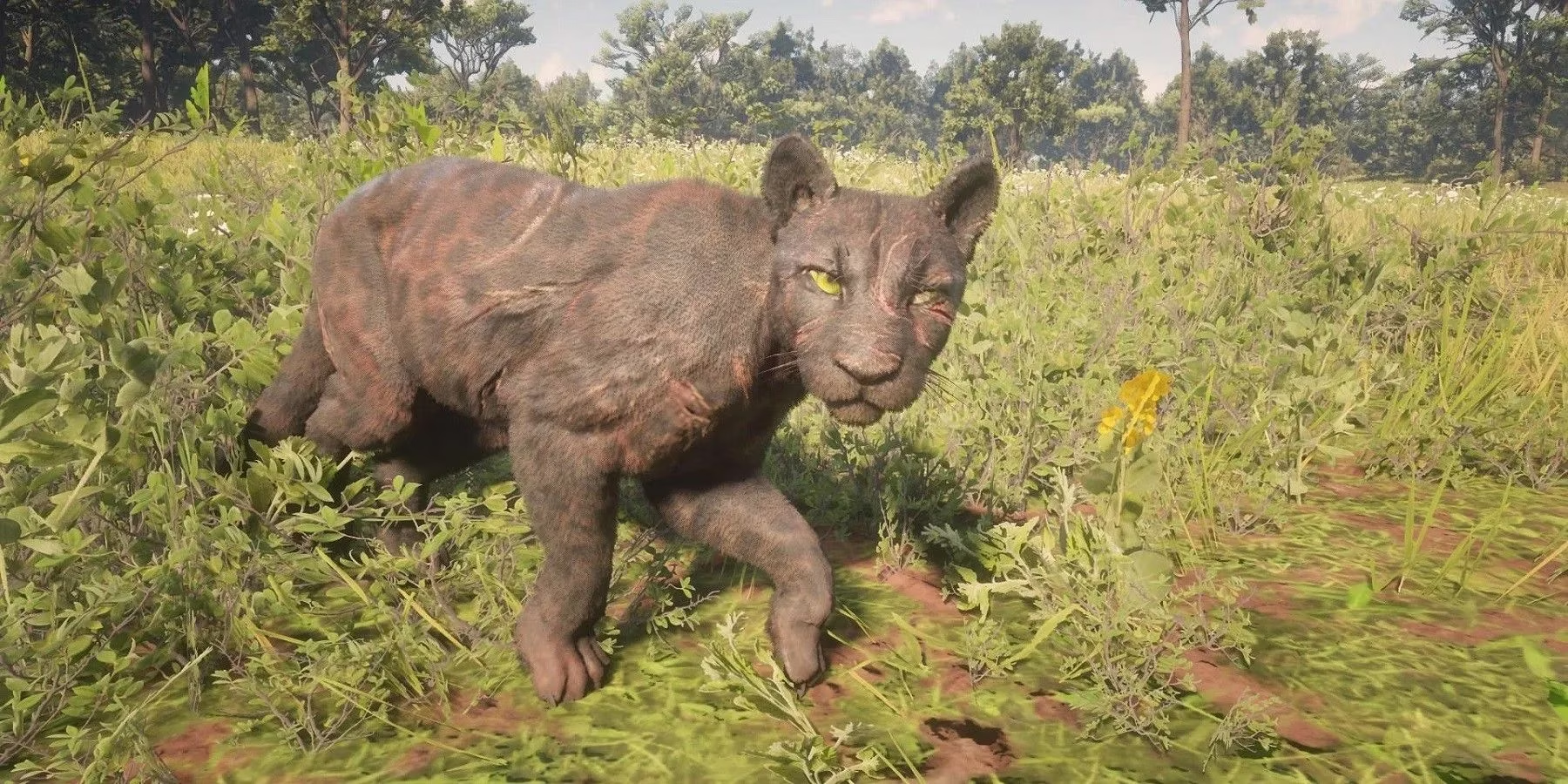
Let me tell you, witnessing a hundred-pound sack of claws and fury get flung like a bag of wet laundry into a cypress trunk reorders your neurons. The collision wasn’t a canned animation; it was a chaotic marriage of ragdoll physics and Rockstar’s borderline obsessive environmental hitboxes. I’ve seen horses trip over pebbles with the drama of a Shakespearean death scene, but using a tree as an execution tool? That felt like discovering you can open a locked door by whispering sonnets to it. The panther’s body folded around the bark like a dropped steak, and I stood there, dumbfounded, my throwing knives still slick with its blood. I had become a wilderness discus thrower.
This wasn’t a scripted event or a hidden side mission. It was born from my own stubbornness. I’d grown bored of repetitive headshots and wanted to transmute my hunting style into something more intimate, more reckless. I switched to improved throwing knives, which turned every encounter into a high-stakes knife-juggling act. The reduced pelt quality was a price I willingly paid for the thrill of tempting a predator to within kissing distance. My aim reticle was off—I’d severed that digital umbilical cord weeks ago to court true danger. Every hunt became a tango with fangs. Earlier that day, a buck had kicked a knife back into my shin and I’d laughed like a madman. The forest was a giant physics engine, and I was its most reckless mechanic.
What makes this moment so gloriously unhinged is that it exposed a layer of simulation most players never scrape. RDR2’s collision architecture is a labyrinth. Trees aren’t just scenery; they are immovable objects with complex surfaces that interact with your horse’s legs, your wagon’s wheels, and, apparently, the trajectory of a flying panther. It’s as if the game secretly stores a miniature god of bounce and deflection inside every piece of bark. During my fifth attempt to replicate the kill (for science, and for the sheer poetry of it), I learned the art of the \u201cpanther parry.\u201d You dodge left, you dodge right, you let the animal commit to its pounce, and then you treat the throw-button combo not as a melee struggle but as a launch command. The panther becomes a living cannonball with a single destination: the hardwood.
The sound it makes is absurdly satisfying—a wet, woody thwump that carries more percussion than any gunshot. I’ve since turned this into a personal sport. I rate each tree by its panther-stopping power. The oaks near Catfish Jackson’s earn a solid 9/10, their bark rough enough to guarantee a mortal wound. Willows are softer, more forgiving; they’re for amateurs. The magnolia trees coated in Spanish moss? They’re the cruel joke of the bayou, often letting the beast tumble through the branches like a drunk trapeze artist before landing on its feet, angrier than ever. My Arthur now mutters \u201ctimber\u201d under his breath every time a big cat meets its wooden executioner.
This is almost certainly not an intended feature, but it has the flavour of something Rockstar left in on purpose, a hidden offering for the devout who spend six thousand hours prodding every seam of the world. In 2026, long after the credits have rolled, the community still unearths these atomic-level interactions. I once saw a player drown a cougar by leading it into knee-deep water and tackling it, but the tree-throw technique is a different beast altogether. It’s a collision kill, a gravity kill, and a humiliation kill rolled into one blood-soaked package. The panther dies not from the knife wounds, but from having its skeleton rearranged by an oak. The pelt is usually poor quality afterward, a ruined tapestry of mangled fur, but I wear those imperfect skins like medals. Each one is a certificate of my lunacy.
Let me frame the absurdity with a metaphor that has no business existing: this hunting method is like trying to slice a tomato by throwing it through a chain-link fence. It shouldn’t work, the mathematics laugh at it, and yet the juices spray and you’re left holding something that vaguely resembles dinner. Another one: the panther’s body becomes a wet balloon filled with angry bees—you can pop it, but the explosion is far more spectacular when you introduce a stationary object. And finally, the whole ordeal felt like I’d just taught a hurricane to play pool: the white ball is a predator’s momentum, the pocket is a tree, and the cue is Arthur Morgan’s desperate, flailing arm.
The real genius lies in how RDR2’s wildlife AI never stops trying to eat you, even when outsmarted. That panther didn’t flee after the first knife wound; it doubled down, committed to the bite, and got turned into woodland pizza. It’s the same AI that makes a charging grizzly bear feel like an avalanche with a grudge. In my 2026 playthrough, with over 2,000 hours logged, I’ve seen deer leap off cliffs rather than face me, and rabbits commit suicide by horse hoof in uncannily realistic ways. The world is a machine of meat and consequence, and I’m just a cowboy with a newfound appreciation for forestry as a combat tool.
So, if you’re still roaming these digital wilds in 2026, I urge you to abandon safe hunting. Dismiss your rifle. Drop the clean headshots. Instead, arm yourself with throwing knives, find a panther, and lead it to the nearest mature hardwood. Dodge, dance, and then throw the animal like you’re trying to impale it on the very air. You might die a dozen times. You might accidentally fling the beast into a soft bush and receive a face full of claws. But when you finally hear that thwump, when you see the animal crumple at the base of an impossibly upright tree, you’ll understand that Red Dead Redemption 2 isn’t just a game about outlaws—it’s a secret, century-spanning textbook on how to weaponize the forest itself. The trees are loading screens into a new dimension of hunting, and I have officially become their most devoted pupil.