Guarma: Red Dead Redemption 2's Misunderstood Masterpiece of Pacing and Character
The Red Dead Redemption 2 Guarma chapter is a brilliantly contentious narrative detour that masterfully showcases Rockstar's audacious storytelling, forcing players to confront the gang's isolation and Dutch's descent into madness.
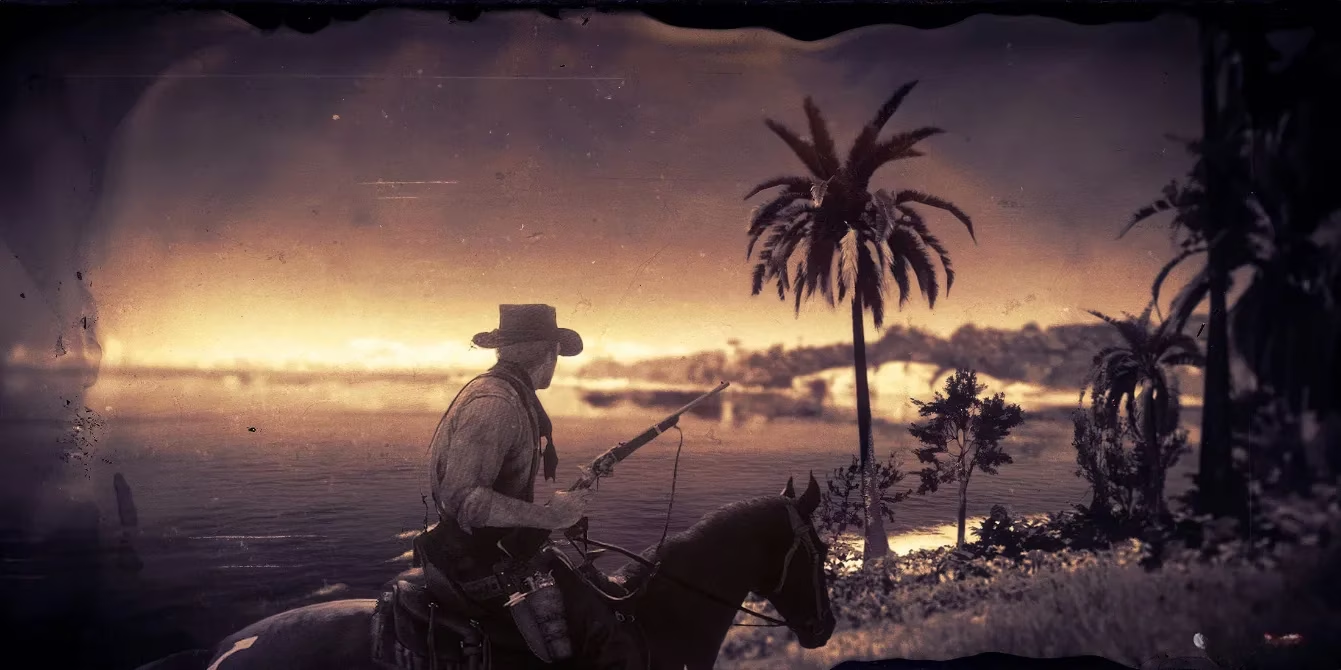
Let me tell you, as someone who's ridden the dusty trails of Red Dead Redemption 2 more times than I can count, the Guarma chapter remains one of the most brilliantly contentious pieces of video game storytelling out there. Even in 2026, six years after its release, folks are still debating it. On the surface, it seems like a jarring detour—you're ripped from the beautifully realized American heartland after the Saint Denis bank heist goes south, stripped of your gear, and dumped on a tropical island. Talk about a vibe shift! But to write it off as a pacing flaw is to miss the forest for the trees. This chapter is, in my humble opinion, Rockstar's storytelling at its most audacious and necessary.
The Narrative Necessity: A Full Stop for Grief
The Saint Denis job was a gut punch, plain and simple. We lost Hosea and Lenny—the gang's moral compass—and saw John captured. The game doesn't just tell you the Van der Linde gang is broken; it shows you by literally shipwrecking them in Guarma. This island isn't just a location; it's a physical manifestation of their isolation and despair. Rockstar forces you, the player, to sit with that failure. You can't just saddle up your favorite horse and ride off to hunt or gamble. You're stuck, just like the gang. This massive slowdown in pace is a feature, not a bug. It lets the emotional weight of Chapter Four truly sink in. Without this breathing room, the gang's downfall would feel rushed. Guarma is where the fantasy of the outlaw life finally, completely shatters.
Dutch's Descent: The True Colors Show
If you want to understand Dutch van der Linde's madness, you must pay attention to Guarma. This is where the mask fully slips. Back in America, Dutch could always talk his way out, always frame his violence as for a 'greater good.' On Guarma, backed into a corner with no easy out, his true nature emerges. He immediately tries to insert himself and the gang into a local rebel conflict he knows nothing about. He uses all his idealistic, noble-sounding language—'fighting for freedom,' 'helping the oppressed'—but it's all a smokescreen. His only real goal is using the chaos to escape. It's a chilling preview of exactly how he will manipulate and ultimately betray the Wapiti tribe back on the mainland. As the saying goes, when the going gets tough, the tough get going—but Dutch just starts lying and manipulating. Guarma is the ominous foreshadowing that makes his actions in Chapter Six and the original Red Dead Redemption tragically inevitable.
A Pragmatic Look: It's Shorter Than You Remember!
I get it, on a repeat playthrough, Guarma can feel like a slog. You just want your guns, your horse, and your freedom back. But let's be real for a second and break it down:
-
Chapter Length: It's one of the shortest chapters in the game, arguably only longer than the tutorial in Chapter One.
-
Mission Count: You're only there for four main story missions.
-
Time Investment: A focused player can be back on the mainland in less than an hour of gameplay.
So, while it feels disruptive, it's actually a very concise narrative interlude. From a strictly pragmatic game design perspective, sure, the gang could have evaded the law in the swamps again. But from a narrative standpoint, that wouldn't have carried the same symbolic weight of utter defeat and dislocation.
The Hidden Gold: World-Building and Isolation
Beyond the main story, Guarma offers unique, if constrained, world-building. It's a glimpse into the global imperialist conflicts of the era, a theme the main game only touches on indirectly. The feeling of being a stranger in a strange land, unable to speak the language or understand the conflict, masterfully translates the gang's aimlessness to the player. You're not a heroic outlaw here; you're just a desperate survivor, and that's a powerful shift in perspective.
The Verdict: A Flawed Diamond
Is Guarma perfect? No. Its linearity and lack of player agency are valid criticisms. But to call it a mistake is to undervalue what it accomplishes. It serves as:
-
An emotional decompression chamber after the trauma of Saint Denis.
-
The crucible for Dutch's character, irreversibly cementing his descent.
-
A powerful symbol of the gang's lost cause and isolation.
Without Guarma, Arthur's return to a dying gang and a crumbling Dutch would lack its profound resonance. The chapter makes you feel the distance—both physical and philosophical—that has grown between them. In a game filled with unforgettable moments, Guarma's harsh, sun-bleached lesson is one of its most essential. It's the game's way of saying, "You've had your fun. Now here's the consequences." And in 2026, that kind of bold, uncompromising storytelling is more valuable than ever.